

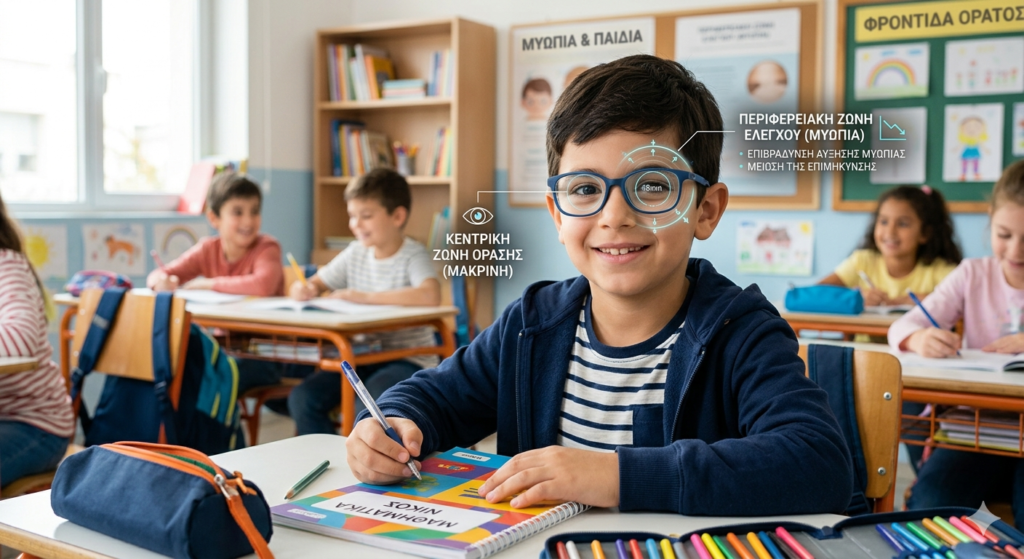
Myopia, also known as short-sightedness or nearsightedness, is one of the most common vision problems worldwide. It is increasingly diagnosed in children and teenagers, and in many cases, myopia continues to progress during childhood and adolescence.
Today, there are several modern options designed not only to correct blurry distance vision but also to slow down the progression of myopia.
These include specially designed spectacle lenses, contact lenses, orthokeratology (Ortho-K), and other myopia management approaches.
What is Myopia Control?
Traditional prescription glasses correct blurred distance vision caused by myopia. Myopia control, also called myopia management, aims to go one step further.
The goal is to help slow the progression of myopia and reduce excessive eye growth, particularly the increase in the eye’s axial length that is associated with progressive myopia.
Myopia control does not necessarily mean that myopia will disappear. Instead, the aim is to reduce how quickly it progresses.
Early assessment and regular monitoring are important, especially when myopia is increasing rapidly.
Types of Myopia Control Lenses
There are several types of spectacle and contact lenses specifically designed for myopia management.
1. Specialised Myopia Control Spectacle Lenses
Modern spectacle lenses for myopia control are different from conventional single-vision lenses.
They are designed with specific optical zones that provide clear central vision while creating a controlled optical stimulus in the peripheral retina.
Different manufacturers use different optical designs and technologies, but the overall goal is similar: to help slow myopia progression while maintaining clear and comfortable vision.
These lenses can be an excellent option for children who are not ready for contact lenses.
2. Lenslet Technology
One of the newer developments in myopia management is lenslet technology.
These spectacle lenses contain numerous small optical elements, known as lenslets, incorporated into specific areas of the lens.
The lenslets create a controlled optical signal in the peripheral visual field while the central area provides the clear vision required for everyday activities.
This technology represents an important development in the field of spectacle-based myopia control.
3. Peripheral Defocus Lenses
Another approach to myopia control uses the principle of peripheral defocus.
Research suggests that the way light is focused on the peripheral retina may play a role in eye growth and myopia progression.
Specially designed lenses can therefore provide clear central vision while creating a specific peripheral defocus pattern.
These lenses are designed to combine everyday visual performance with a myopia management strategy.
4. Multi-Zone Myopia Control Lenses
Some specialised lenses use multiple optical zones to create a controlled visual signal.
The different areas of the lens are designed to provide the appropriate optical correction while influencing peripheral retinal focus.
These designs are part of the growing range of myopia control spectacle lenses available today.
Are All Myopia Control Lenses the Same?
No.
The term myopia control lenses covers several different technologies and optical designs.
Their effectiveness may vary depending on the lens technology, the child’s age, the level of myopia, how quickly the prescription is changing, and other individual factors.
For this reason, choosing a myopia control lens should not simply be based on the prescription.
A personalised approach is important when deciding which myopia management option may be appropriate.
Other Myopia Management Options
Spectacle lenses are not the only option available.
Depending on the child’s age, prescription, lifestyle and suitability, other approaches may also be considered.
5. Myopia Control Contact Lenses
Specialised myopia control contact lenses are designed to correct vision while providing an optical design intended to slow myopia progression.
Some contact lenses use different optical zones to create a specific peripheral defocus pattern.
Contact lenses can be an option for older children and teenagers who can safely and responsibly manage lens handling and hygiene.
Proper fitting, cleaning, wearing schedules and follow-up are essential.
6. Ortho-K – Orthokeratology
Orthokeratology (Ortho-K) uses specially designed rigid gas-permeable contact lenses that are worn overnight.
While the person sleeps, the lenses temporarily reshape the corneal surface. This can provide clear vision during the day without wearing conventional glasses or contact lenses.
Ortho-K is also used as part of myopia management in appropriate cases.
Because the lenses are worn overnight, proper fitting, hygiene and professional follow-up are particularly important.
7. Low-Dose Atropine
Low-dose atropine is another approach that may be used as part of a myopia management strategy.
It is a pharmaceutical treatment and should only be used following assessment and monitoring by an appropriate eye-care professional.
Atropine is not a spectacle lens or contact lens and should not be used without appropriate medical guidance.
8. Spending More Time Outdoors
Lifestyle can also play an important role in children’s eye health.
Research has associated increased time spent outdoors with a lower risk of developing myopia.
Children should also be encouraged to take regular breaks during prolonged near work, maintain an appropriate working distance and use screens and books in suitable lighting conditions.
These habits do not replace a myopia management programme, but they can form an important part of a comprehensive approach.
How Is the Right Myopia Control Option Chosen?
There is no single myopia control solution that is ideal for every child.
The most appropriate approach may depend on:
- The child’s age
- The level of myopia
- How quickly the prescription is changing
- Family history of myopia
- Time spent on near activities
- Time spent outdoors
- Lifestyle and sports activities
- Ability to handle and care for contact lenses
- The child’s individual visual needs
- Suitability of each available treatment
For this reason, myopia management should be personalised.
Why Is Regular Myopia Monitoring Important?
Simply changing a child’s glasses whenever the prescription becomes stronger may not always be enough.
A myopia management programme should include regular monitoring of the child’s vision and, where available and appropriate, measurements such as axial length.
Monitoring the progression of myopia helps eye-care professionals evaluate how the child’s eyes are developing and determine whether the current management strategy should be continued or adjusted.
When Should a Child Be Assessed for Myopia?
A professional eye assessment may be particularly important if a child:
- Has difficulty seeing the board at school
- Sits very close to the television or screen
- Holds books or digital devices very close
- Has difficulty recognising people or objects from a distance
- Frequently squints to see clearly
- Complains that distant objects look blurry
- Has rapidly increasing myopia
- Has parents or close family members with myopia
Early detection can provide more opportunities to manage progressive myopia.
Myopia Management at PHOS Optical Store
At PHOS Optical Store in Pagrati, Athens, we provide information and support regarding modern options for myopia control in children and teenagers.
Depending on the individual case, available options may include:
• Myopia control spectacle lenses
• Specialised contact lenses
• Ortho-K / Orthokeratology
• Myopia management solutions
• Monitoring of myopia progression
The most appropriate option should always be selected according to the individual’s needs and in cooperation with the appropriate eye-care professional.
Contact PHOS Optical Store
PHOS Optical Store
Pagrati, Athens, Greece
📍 Filolaou 48 Street, Pagrati, Athens
📞 +30 211 0028 761
🌐 phosoptical.gr